
Case Study: An electrical connector design had an 18mm total length envelope, requiring 5N of preload force across a 1.5mm operating stroke. A helical wire compression spring calculated to a 6mm free height—far too long to fit. Switching to a multi-turn wave spring reduced the required free height to 2.2mm, saving 63% of the axial space.
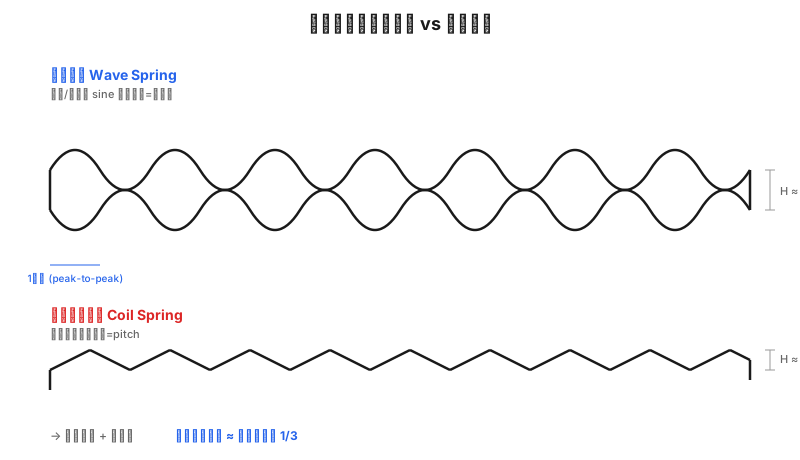
Core Distinction: Wave Springs — Compact axial space, moderate force, flat deflection profile. Coil Springs — Broad load range, extensive deflection strokes, low automated unit cost.
3 Scenarios Where Wave Springs Are the Clear Choice
1. Axial Space < 6mm — Helical springs bottom out solid with insufficient active coils; wave springs fit naturally; 2. Generous Radial Space, Constrained Axial Space — Motor bearing preload packs, rotary mechanical seals, and hydraulic valves; 3. Low Spring Rate with Moderate Load — Electrical contact pins and precision valves requiring tight force tolerances over 0.5-3mm strokes.
3 Scenarios Where Helical Springs Remain Superior
1. High Loads > 500N or Ultra-Light Loads < 0.5N — Wave springs face geometric manufacturing limits; 2. High-Volume Production > 100,000 pcs/year — High-speed automatic coiling machines produce wire springs at unbeatable economies of scale; 3. Severe Corrosive or Thermal Environments > 300°C — Standard high-temp wire chemistries are more readily available in round wire formats.
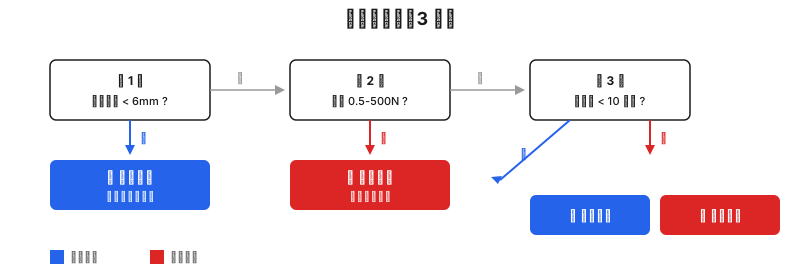
3-Step Decision Logic
Step 1: Is axial clearance < 6mm? → If Yes → Choose Wave Spring. If No → Go to Step 2. Step 2: Is target load between 0.5N and 500N? → If No → Choose Helical Coil. If Yes → Go to Step 3. Step 3: Is annual volume < 100,000 units? → If Yes → Wave Spring provides rapid tooling-free delivery. If No → Helical Coil may be more cost-effective.
Send us your technical drawings: TOSTA delivers preliminary spring calculations and DFM feedback within 1 business day. Flexible production runs from 100 pieces up to mass production.