
Engineering Problem: A single Belleville disc spring (OD = 50mm) provides only 0.5mm of working deflection. How can a design achieve 1.5mm stroke while sustaining a 200N clamping force? The solution lies in stacking. Understanding parallel, series, and combined configurations is essential for mechanical designers.
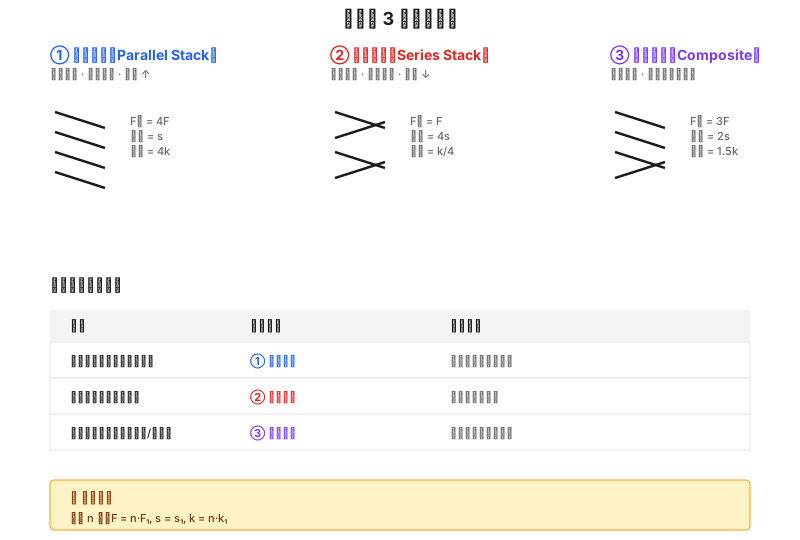
1. Parallel Stacking (Nested in Same Direction)
N discs stacked face-to-face in the same direction: Total Force = n * F1; Total Deflection = s1 (unchanged). Application: When high loads are needed within a fixed, short stroke—such as stamping die preloads, valve packing glands, and heavy bolting.
2. Series Stacking (Alternating Peak-to-Peak)
N discs stacked in alternating directions: Total Force = F1 (unchanged); Total Deflection = n * s1. Application: When long travel is required at constant force—such as heavy shock absorbers, thermal expansion compensators, and cable tensioners.
3. Combined / Mixed Stacking
Grouping parallel sets in series (e.g., three sets of two parallel discs): Total Force = n_parallel * F1; Total Deflection = n_series * s1. Application: CNC machine tool spindles, hydraulic presses, and heavy braking systems requiring both massive force and extended deflection.
Stacking Rules: Do not stack more than 4 discs in parallel; internal rim friction exceeds 15%, causing severe hysteresis. In mixed stacks, contact interfaces must be properly lubricated with MoS2. DIN 6796 prohibits stacking more than 3 discs.
Common Engineering Traps to Avoid
1. Omitting Internal / External Alignment Guides → Discs slip off-center, causing localized plastic yield; 2. Inadequate Lubrication in Parallel Packs → Friction creates a 20% load disparity between inner and outer discs; 3. Inverting Disc Orientation → The spring pack delivers only 1/n of the planned force.
Need assistance calculating stack parameters? Provide your required preload, stroke, and cavity dimensions—TOSTA provides optimized stacking schemes within 1 business day.