
Calculating Belleville disc spring preload appears straightforward on paper, but if any of five subtle engineering details are overlooked, even the most rigorous mathematical formula cannot prevent premature field failure.
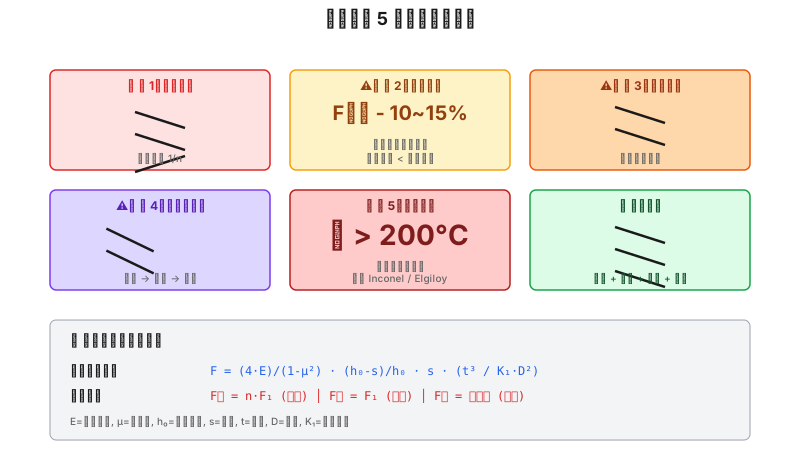
Mistake 1: Inverting Assembly Direction
Rule of Thumb: Ensure bearing surfaces point outward toward supporting flanges. If an alternating disc is accidentally installed backward, individual disc force drops to 1/n and the stack binds solidly under partial load.
Mistake 2: Overlooking Frictional Hysteresis
Theoretical Force = F; Real Measured Force = F * (1 - 10% to 15%). Friction between sliding disc edges absorbs force, resulting in lower applied preload during compression. Compensate in design by sizing for F_actual * 1.12.
Mistake 3: Inadequate Inter-Disc Lubrication
Stacked disc spring packs must be lubricated with molybdenum disulfide (MoS2) or high-temperature graphite paste. Without grease, inter-disc friction induces localized galling, uneven load sharing, and premature fatigue cracking.
Mistake 4: Insufficient Guide Rod / Sleeve Length
The length of guide pins or guide bushings must equal >= 1.5x the free stack height. If guides are too short, unconstrained top discs cock sideways, causing eccentric loading, bore scoring, and rapid failure.
Mistake 5: Exceeding Alloy Thermal Limits
Standard 50CrV4 spring steel degrades rapidly above 200°C. For high-temperature turbine valves or downhole tooling, mandate Inconel 718 or Elgiloy; standard carbon spring steels will undergo severe load relaxation and permanent set within months.
Core Belleville Formula: F = (4*E / (1 - mu^2)) * ((h0 - s) / h0) * s * (t^3 / (K1 * D^2)). Eliminate these 5 installation pitfalls before finalizing calculations. TOSTA manufactures standard DIN EN 16983 (DIN 2093) disc springs and custom engineered stacks.